Exclusive YouGov research commissioned by Answer4u reveals how UK consumers feel about AI in customer service and how they want businesses to communicate.
Key Findings
- 90% of UK adults prefer interacting with a real person rather than an AI system when contacting a businesss.
- Nearly three quarters (74%) strongly prefer speaking to a real person, highlighting the continued importance of human interaction in customer service.
- Only 2% of respondents said they prefer interacting with an AI system, suggesting that consumers still see people as the preferred option for most business conversations.
- Older consumers are the strongest advocates for human interaction, with those aged 55 and over showing the highest preference for speaking to a real person.
- Younger adults are slightly more open to AI, although a clear majority still prefer human interaction.
- Women showed a marginally stronger preference for speaking with a real person than men, reinforcing the wider trend across all demographics.
- Despite the rapid adoption of AI, human interaction remains the gold standard for customer service.
Introduction
Customer service is changing faster than ever before.
Artificial intelligence is transforming the way businesses answer calls, respond to enquiries and support customers. From AI-powered phone systems and virtual receptionists to chatbots and automated assistants, organisations are embracing new technology to improve efficiency, increase availability and manage growing demand.
Yet as AI adoption accelerates, one important question remains.
Are customer expectations changing at the same pace?
To better understand how consumers feel about AI in customer service, Answer4u commissioned YouGov to survey more than 2,000 UK adults about their preferences when contacting a business.
This report explores what the findings reveal about changing customer expectations, where AI genuinely adds value, and why the future of customer service may lie in combining intelligent automation with the human touch.
Research Findings
The findings reveal a clear message:
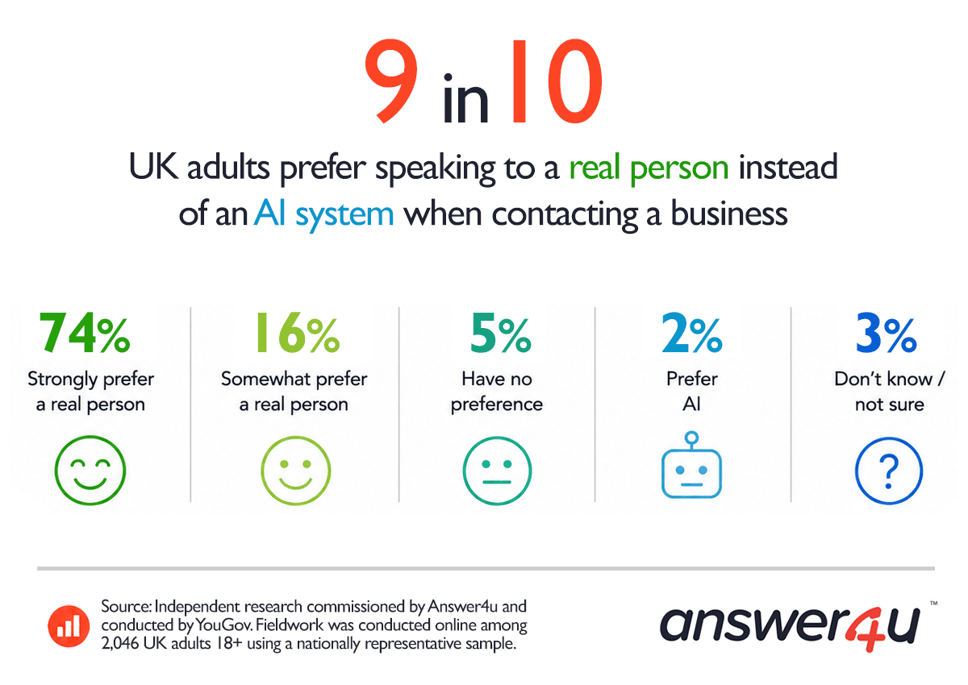
Despite rapid advances in AI, 90% of UK consumers still prefer speaking with a real person.
When asked whether they would rather interact with a real person or an AI system when contacting a business, the results were striking.
- 74% strongly prefer speaking with a real person.
- 16% somewhat prefer speaking with a real person.
- Just 2% prefer interacting with an AI system.
- 5% have no preference.
- 3% remain unsure.
- Overall, 90% of UK adults favour human interaction.
This is one of the clearest indicators yet that, despite growing investment in AI, customer expectations continue to centre around human communication
"Businesses often assume the conversation is about choosing between AI and people. Our experience tells us it's a much more practical decision than that. Customers want quick answers when their enquiry is straightforward, but they also want confidence that a knowledgeable person is available when the conversation becomes more important.
The businesses that succeed over the next decade will be those that understand where technology adds value and where the human touch continues to make the difference."
Mark Menhennet, Co-Founder, Answer4u
Age Matters
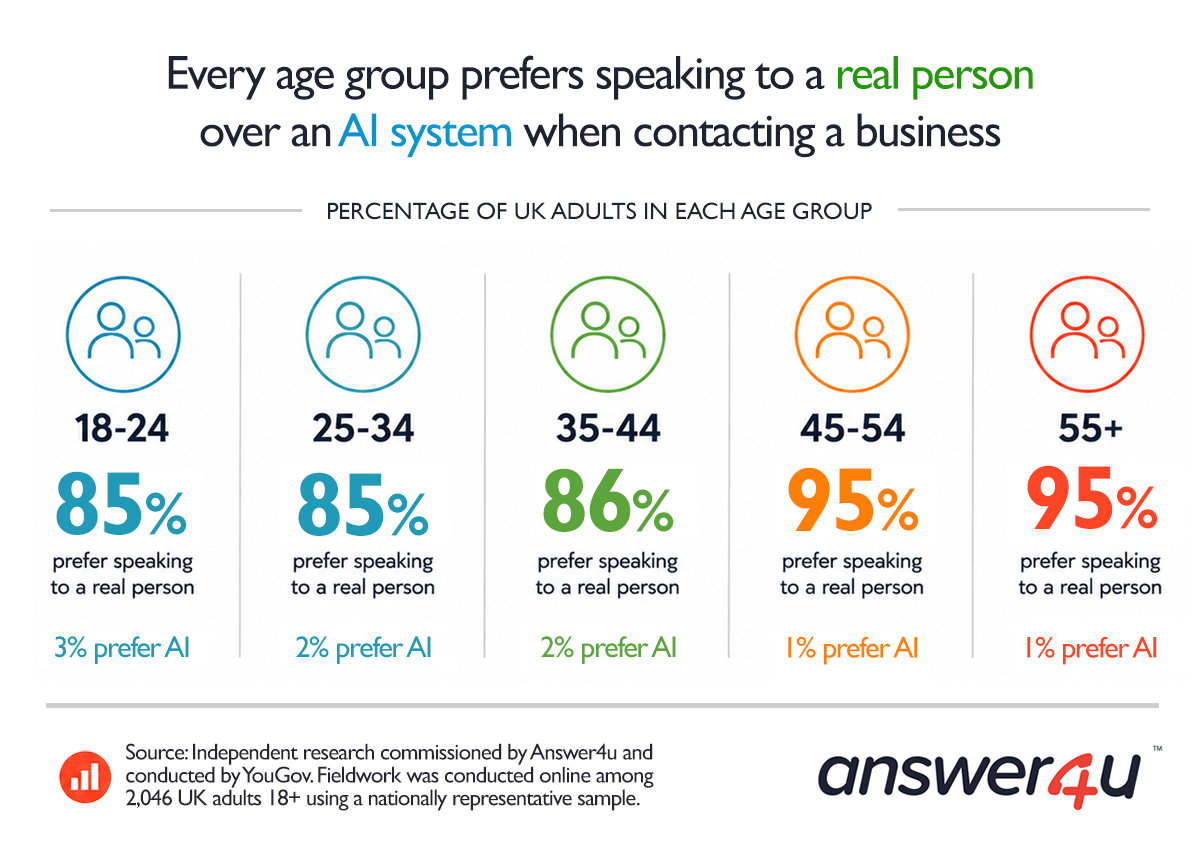
While every age group preferred speaking with people, attitudes varied.
Older consumers showed the strongest preference for human interaction.
Among those aged 55 and over, more than eight in ten strongly preferred speaking with another person.
Younger adults were slightly more open to AI, although even within the 18-24 age group, a clear majority still favoured human interaction.
Rather than signalling a generational divide, the research suggests that comfort with AI exists alongside an ongoing desire for personal service.
Women show an even stronger preference for human interaction
The survey also revealed modest differences between men and women.
Women were slightly more likely than men to say they preferred speaking with a real person.
While the difference is relatively small, it reinforces the broader finding that consumers continue to place considerable value on human interaction when dealing with businesses.
Why People Still Choose People
The research raises an important question.
If AI has become so capable, why do customers still overwhelmingly prefer speaking to another person?
The answer is unlikely to be about technology alone. Customer service is often more than simply exchanging information. It involves reassurance.
Understanding. Flexibility. Empathy.
When customers contact a business, they may be making a complaint, discussing a financial matter, explaining a medical issue or simply feeling frustrated.
In these situations, they are often looking for understanding as much as information.
"Every day we see conversations that simply can't be reduced to a script. Customers might be frustrated, worried or unsure what information they need to provide. A well-trained adviser doesn't just answer the question, they listen, adapt their approach and build trust. Those are the moments that shape how customers remember a business."
Sally-Ann O'Neill, Head of Call Centre Operations
Human conversations provide context, emotional intelligence and the ability to adapt naturally when circumstances change.
These qualities remain difficult for even the most advanced AI systems to replicate consistently.
Where AI Adds Genuine Value
None of this suggests businesses should avoid AI. Far from it.
Automation can significantly improve the customer experience when used appropriately. AI is particularly effective for:
- Answering frequently asked questions.
- Providing opening hours and location information.
- Taking messages.
- Booking appointments.
- Directing callers to the correct department.
- Providing 24-hour availability.
- Managing periods of exceptionally high demand.
For many businesses, these routine interactions represent a large proportion of incoming enquiries. Handled well, AI can reduce waiting times and allow customers to receive immediate answers.
In these situations, automation is often valued because it removes friction rather than creating it.
The Rise of the Hybrid Customer Experience
The findings point towards an emerging trend.
Rather than replacing people altogether, businesses are increasingly exploring how AI can support customer service teams rather than replace them.
Automation can manage repetitive, straightforward enquiries quickly and consistently.
Human advisers can focus on conversations requiring expertise, empathy, judgement or problem-solving.
This allows organisations to improve efficiency while protecting the quality of customer interactions where it matters most.
For consumers, this balance offers the best of both worlds. Routine enquiries are resolved quickly. More complex conversations remain personal.
"AI has an important role to play in modern customer service, particularly when it comes to handling routine enquiries quickly and consistently. The challenge for businesses isn't deciding whether to adopt AI, it's deciding where automation improves the customer experience and where a skilled person still delivers greater value. The most effective customer service strategies are likely to combine both."
Stuart Wilson, Director of Operations
The future of customer service may therefore be less about choosing between AI and people, and more about understanding when each delivers the greatest value.
What This Means for Businesses
As AI becomes more accessible, businesses should resist viewing automation as an all-or-nothing decision.
Instead, leaders should consider where technology genuinely improves the customer experience and where human interaction continues to create trust.
Before implementing AI, organisations should ask themselves:
- Which customer enquiries are repetitive and suitable for automation?
- Which conversations require empathy or judgement?
- How easily can customers reach a person when needed?
- Does automation reduce effort or simply create another barrier?
- Will the experience strengthen or weaken customer relationships?
Businesses that answer these questions thoughtfully are likely to see the greatest long-term benefits from AI.
Conclusion
Artificial intelligence is changing customer service. That much is certain.
However, this research suggests that customer expectations remain firmly rooted in human connection. Consumers are not rejecting AI. They are asking businesses to use it wisely.
Automation has a valuable role to play in making organisations more responsive, more accessible and more efficient. Yet when conversations become important, emotional or complex, people still place their trust in other people.
"Customer service has never stood still. Over the past twenty years we've seen new technologies transform how businesses communicate, but one thing has remained consistent: customers remember how you made them feel. Technology can improve speed and efficiency, but lasting customer relationships are still built on trust, empathy and good communication."
David Chapman, Customer Service Director
For businesses, the opportunity lies not in replacing the human touch, but in combining technology with great customer service to create experiences that are both efficient and genuinely customer-focused.
Methodology
Research commissioned by Answer4u and conducted by YouGov. Fieldwork was conducted online among 2,046 UK adults 18+ using a nationally representative sample. Fieldwork was undertaken between 5th - 8th June 2026.
Respondents were asked:
When contacting a business, which of the following best describes your preference for interacting with a real person versus an AI system?
- I strongly prefer interacting with a real person.
- I somewhat prefer interacting with a real person.
- I have no preference.
- I somewhat prefer interacting with an AI system.
- I strongly prefer interacting with an AI system.
- Don't know / not sure.
About the Author
Darren McCowan is Director of Marketing at Answer4u and has more than 30 years of experience developing marketing strategies for established UK brands. He specialises in customer experience, telephone answering services, contact centre operations and lead generation.
At Answer4u, Darren regularly writes about customer service trends, business communications, call management and outsourced support solutions, helping business owners make informed decisions about how they engage with their customers.