New YouGov research commissioned by Answer4u reveals how quickly UK consumers lose patience with unanswered business calls, and why missed calls could be costing businesses valuable customers.
Key Findings
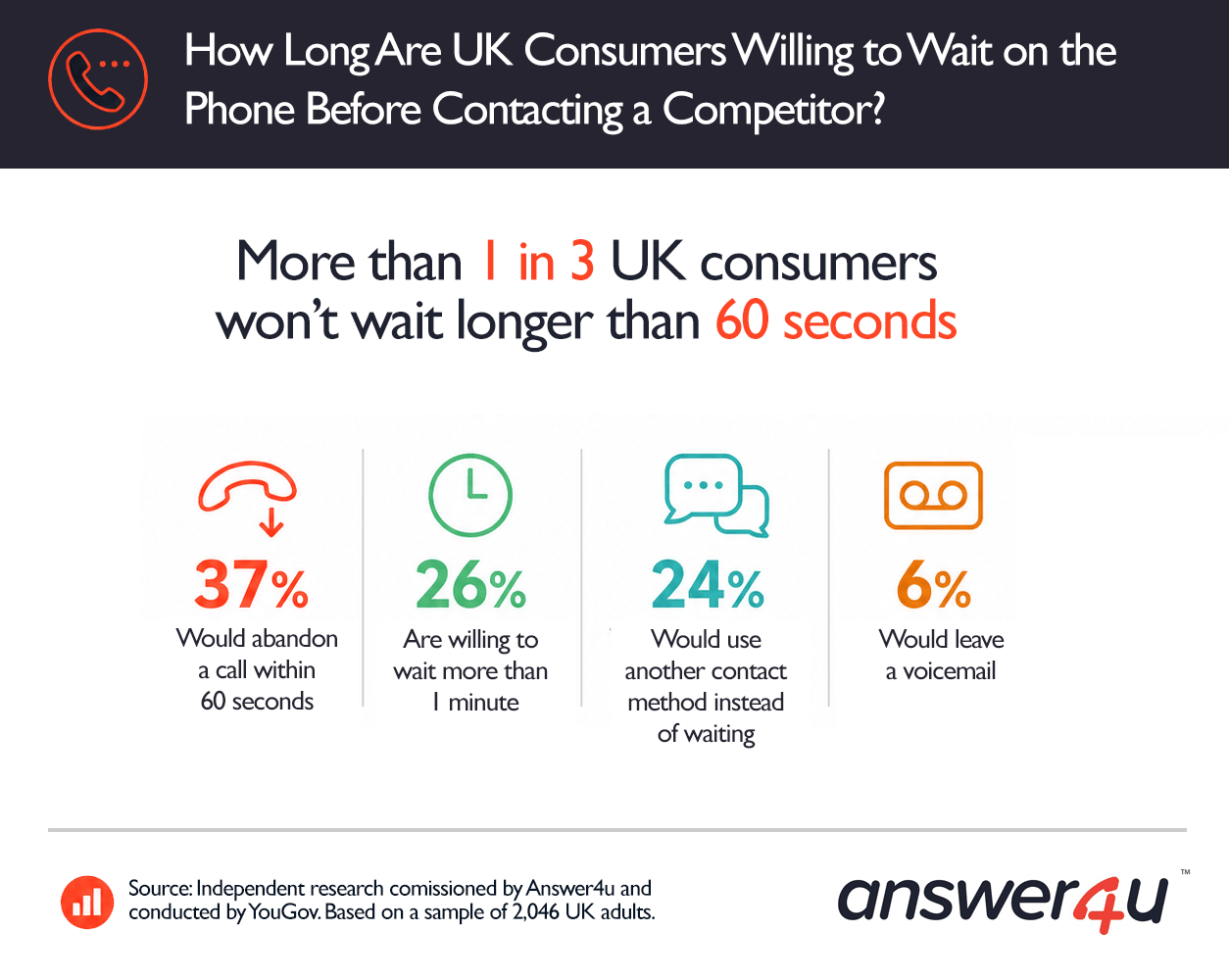
- More than one in three UK consumers will abandon a business call within 60 seconds.
- 18% would wait less than 30 seconds.
- 6% would leave a voicemail rather than waiting.
- Nearly one in four would switch to another contact method rather than continue waiting.
- Women (28%) are significantly more likely than men to seek alternative ways to contact a business rather than continue waiting for their call to be answered.
- Consumers aged 25–44 showed the lowest tolerance for waiting, with only 53% saying they would wait for their call to be answered.
- Younger consumers show the lowest tolerance for waiting on the phone
- The findings suggest that unanswered calls could be driving customers directly to competitors.
Introduction
For many businesses, every incoming call represents a potential customer. However, unanswered calls can quickly become missed opportunities.
To better understand how consumers respond when a business fails to answer the phone, Answer4u commissioned independent research through YouGov. The survey explored how long UK adults would wait before deciding to contact a competitor instead.
The findings reveal a clear warning for businesses that struggle to answer calls promptly. Whether you're a sole trader, SME or large organisation, failing to answer the phone quickly could mean losing customers before you've even had the chance to speak to them.
The Results
1. More Than One in Three Consumers Will Hang Up Within a Minute
The research found that 37% of UK adults would abandon a business call within the first 60 seconds.
This includes:
- 1% who would hang up immediately.
- 4% who would wait just 1–10 seconds.
- 14% who would wait between 11–30 seconds.
- 18% who would wait between 31–60 seconds.
These findings suggest that businesses have a very limited window to answer incoming enquiries before customers begin looking elsewhere.
For businesses operating in highly competitive sectors, a missed call may not simply be a missed conversation. It could be a lost customer.
2. Two-Thirds of Consumers Won't Wait Beyond One Minute
While 26% of respondents said they would wait longer than one minute, the majority indicated they would take action sooner.
When combining those who would hang up, switch channels or leave a voicemail, the data shows that most consumers are unwilling to wait even for a short period of time.
The message is simple: customers expect businesses to be available when they call.
"67% of consumers would either hang up or consider taking alternative action rather than continue waiting on the phone."
Darren McCowan, Director of Marketing
For many businesses, an unanswered call may increase the risk of a prospective customer looking elsewhere.
3. Voicemail Is Losing Relevance
One of the most striking findings from the research is the low number of people willing to leave a voicemail.
Just 6% of respondents said they would leave a message rather than waiting for their call to be answered.
By comparison:
- 24% would use another contact method such as email or live chat.
- 37% would abandon the call entirely.
For businesses that rely on voicemail as a safety net, this finding raises an important question:
If customers aren't leaving messages, how many opportunities are being lost without your knowledge?
"There is definitely a low uptake on leaving voicemails and it's clear customers generally prefer channels that provide immediate response or confirmation that their enquiry has been received. I believe many see voicemail as a slower, less reliable route."
Sally-Ann O'Neil, Head of Call Centre Operations
4. Women Are More Likely to Seek Alternative Contact Methods
The research highlights a notable difference between male and female consumers.
Among women:
- 28% would switch to another contact method.
- 8% would leave a voicemail.
Among men:
- 20% would switch contact methods.
- 4% would leave a voicemail.
This suggests female consumers are significantly more likely to continue their enquiry through another channel when faced with a delayed phone response.
Businesses that provide seamless communication across phone, email and live chat may therefore be better positioned to retain potential customers.
5. Younger Consumers Have Less Patience for Unanswered Calls
The data also reveals clear differences between age groups.
Consumers aged 25-34 were the most likely to abandon the phone and move to another channel, with 29% saying they would use an alternative contact method.
Similarly, 28% of those aged 35-44 said they would do the same.
These findings reflect broader shifts in customer behaviour, where consumers increasingly expect fast, frictionless communication and immediate responses.
"In recent years there has been an obvious move towards customers using various customer service channels. Customers will use phone, email, webchat, social media and messaging to gain a prompt response and although AI is helping to improve efficiency, its clear customers still want quick access to a person – especially for more complex issues."
Sally-Ann O'Neil, Head of Call Centre Operations
What This Means for UK Businesses
For many businesses, every inbound call represents a potential sale, enquiry or new customer relationship. Yet the research suggests that a significant proportion of callers may never reach voicemail, leave a message or try again if their initial call is unanswered.
This is particularly relevant for:
- Tradespeople working on-site.
- Estate agents handling viewings.
- Legal firms in client meetings.
- Healthcare providers.
- Financial services businesses.
- Property management companies.
- Growing SMEs with limited front-of-house resources.
In each of these industries, unanswered calls can quickly translate into lost business.
The Cost of a Missed Call
Customers today expect quick responses and easy access to businesses. When nobody answers the phone, many consumers simply move on.
For smaller businesses, this presents a particular challenge. Business owners often juggle client work, meetings, site visits and administration, making it difficult to answer every call personally.
The findings suggest that having a professional call answering solution in place may no longer be viewed as a convenience. For many businesses, it is becoming an essential part of protecting revenue and delivering a positive customer experience.
"A caller's experience begins the moment they dial your phone number. No matter how good a business is, or how strong its customer service may be, none of that matters if the caller never gets to speak to someone. Our research shows that businesses have a very small window to make a positive first impression, and that window starts long before the conversation begins."
Stuart Wilson, Director of Operations
Methodology
Research commissioned by Answer4u and conducted by YouGov. Fieldwork was conducted online among 2,046 UK adults 18+ using a nationally representative sample. Fieldwork was undertaken between 5th - 8th June 2026.
Respondents were asked:
"Thinking about a time you needed to contact a business by phone, how long, if at all, would you be willing to wait for a business to answer your call before deciding to contact a competitor instead?"
About the Author
Darren McCowan is Director of Marketing at Answer4u and has more than 30 years of experience developing marketing strategies for established UK brands. He specialises in customer experience, telephone answering services, contact centre operations and lead generation.
At Answer4u, Darren regularly writes about customer service trends, business communications, call management and outsourced support solutions, helping business owners make informed decisions about how they engage with their customers.